
Hot tire pickup happens when heated tires soften an epoxy garage floor coating, bond to it as they cool, and peel sections of the coating off the concrete when the car moves. The result is patches of bare concrete surrounded by intact coating. Cleveland Concrete Coatings prevents this by installing polyurea polyaspartic systems that don’t soften under tire heat.
Most homeowners blame the installer when their coating peels under the tires. The real problem isn’t the application technique. Standard epoxy has a low heat-deflection temperature, meaning the resin softens at temperatures hot tires routinely reach after highway driving. No amount of prep quality fixes a material that softens at 140°F.
What Causes Hot Tire Pickup on Epoxy Floors
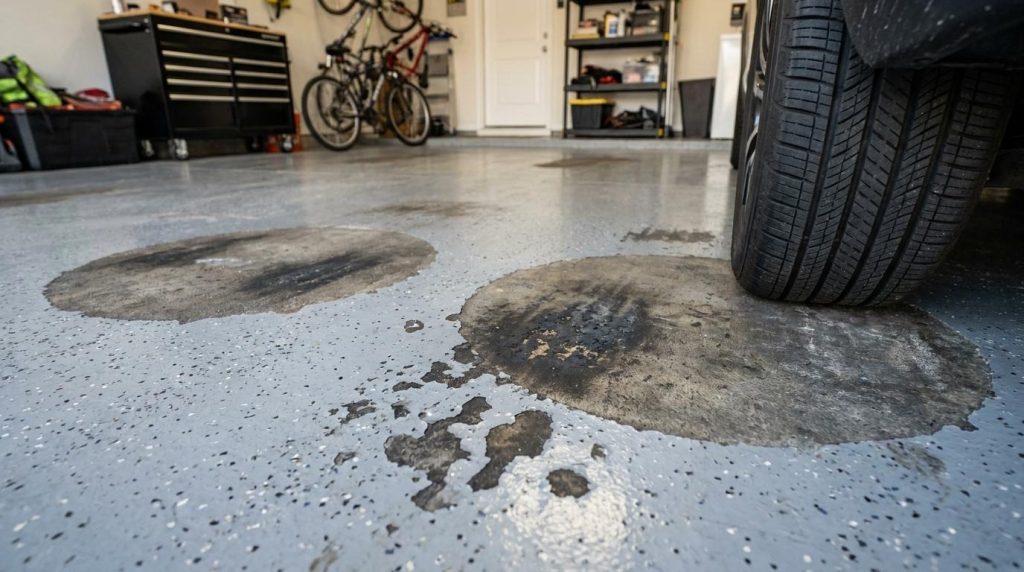
After highway driving, tire surface temperatures reach 130°F to 160°F. When you park on an epoxy floor, that heat transfers directly into the coating. Standard epoxy’s heat-deflection point sits around 130°F to 140°F, which means the resin softens every time you park after a drive.
As the tire cools, it contracts and forms a bond with the softened epoxy. When you drive away next, the tire pulls the softened coating right off the concrete. This cycle repeats with every drive, gradually enlarging the bare patches. The damage is cumulative and shows up faster in warm months when both tire and ambient temperatures are higher.
Three factors determine how quickly hot tire pickup appears:
- Coating thickness. Thinner DIY epoxy kits fail fastest because less material means less heat capacity before softening.
- Surface preparation. Poor adhesion from acid etching instead of diamond grinding means the coating releases from concrete more easily under stress.
- Resin quality. Water-based and low-solids epoxies soften at lower temperatures than 100% solids formulations. This is one of several common epoxy flooring problems that stem from material chemistry rather than installation error.
Why Polyurea Polyaspartic Resists Hot Tire Pickup

Polyurea polyaspartic coatings have a heat-deflection temperature well above what any tire produces. The molecular structure doesn’t soften at temperatures below 200°F, which means hot tires don’t generate enough heat to soften the coating surface. No softening means no bonding, and no bonding means no peeling.
Cleveland Concrete Coatings installs polyurea polyaspartic garage floor systems that are specifically rated for hot tire contact. The system also handles the Cleveland-specific factors that make hot tire pickup worse: summer heat that pre-warms the garage slab, salt residue on tires that acts as a chemical irritant, and the daily parking cycles of commuter vehicles. For homeowners wondering whether epoxy floors are slippery, polyurea’s textured flake finish also provides better traction than smooth epoxy in wet conditions.
What to Do If You Already Have Hot Tire Damage
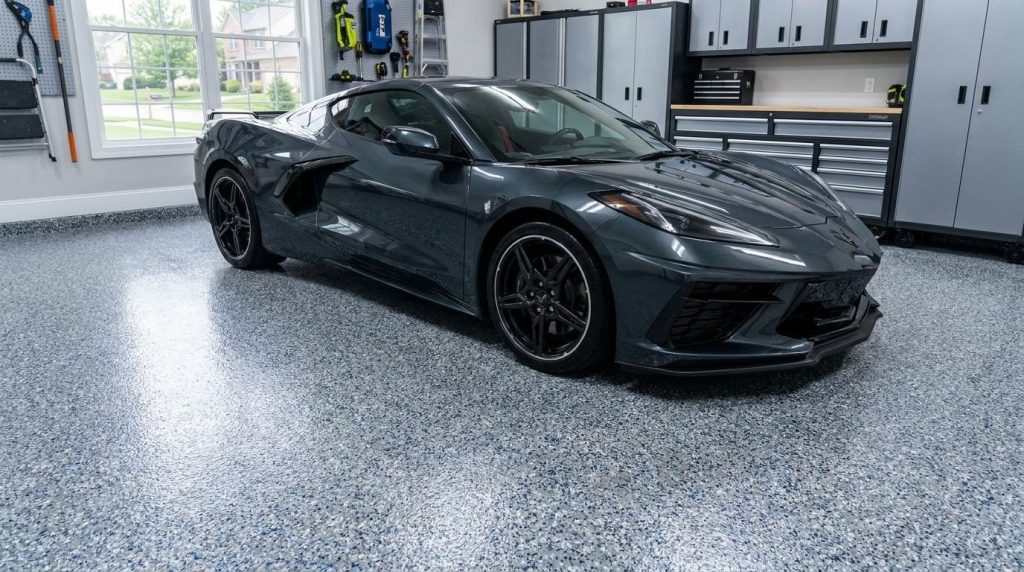
Patching hot tire damage on an epoxy floor is a temporary fix. The new epoxy will soften under the same tire heat that damaged the original coating. The most reliable long-term solution is removing the epoxy entirely and replacing it with a coating chemistry that doesn’t have a thermal softening point in the range of tire temperatures.
The removal and replacement process involves diamond grinding the damaged epoxy back to bare concrete, then applying a full polyurea polyaspartic system. Cleveland Concrete Coatings completes this in a single day. The best garage floor coating for preventing hot tire pickup long-term is one that eliminates the root cause rather than adding another layer of the same material that already failed.
Frequently Asked Questions
Will a thicker epoxy coat prevent hot tire pickup?
A thicker layer delays the damage but doesn’t prevent it. The resin still softens at the same temperature regardless of thickness. More material means slightly more thermal mass to absorb heat before reaching the softening point, but with daily parking cycles, thicker epoxy fails the same way within a year or two longer.
Does hot tire pickup happen in winter when tires are cold?
Less frequently, but it still occurs. Even in cold weather, highway driving generates enough friction to heat tire surfaces above 130°F. The damage accumulates more slowly in winter because ambient temperatures cool the tire faster after parking. Summer is when most Cleveland homeowners first notice the problem.
Can I apply a topcoat over my existing epoxy to stop hot tire pickup?
A polyurethane or polyaspartic topcoat over epoxy provides temporary protection, but the underlying epoxy still softens under heat. Once the topcoat wears through in high-contact areas, the hot tire cycle resumes. Cleveland Concrete Coatings recommends a full-system replacement rather than layering over a compromised base.
Stop Hot Tire Damage Before It Starts

Hot tire pickup is a material limitation, not an installation failure. Epoxy softens under tire heat because its molecular structure wasn’t designed for sustained thermal contact. Polyurea polyaspartic was. The choice is between a coating you’ll replace within a few years and one that handles daily parking without degradation throughout the life of your floor.Cleveland Concrete Coatings installs hot-tire-resistant polyurea systems for homeowners in Rocky River and across greater Cleveland in one day with zero VOC fumes. Contact us or call (216) 280-9477 to get a free estimate for your garage floor.

Benjamin & Andrew Smola are the owners of Cleveland Concrete Coatings, a concrete coating company based in Cleveland. With a hands-on approach and local expertise, Benjamin, Andrew, and their team are dedicated to delivering durable, high-quality flooring solutions for homes and businesses throughout the area.