
Commercial kitchen floor coating for Cleveland restaurants must handle thermal shock, chemical exposure, constant moisture, and heavy foot traffic while maintaining slip resistance and sanitation compliance. Polyurea polyaspartic, epoxy, and urethane cement are the leading systems for food service environments. Cleveland Concrete Coatings installs commercial kitchen floor coatings for restaurants and food service businesses across Greater Cleveland and Northeast Ohio.
A kitchen floor failure in a restaurant doesn’t start with a dramatic crack. It begins with a worn section near the fryer that gets slippery during the dinner rush. Then a seam lifts near the walk-in cooler and catches a cart wheel. A health inspector later flags the deteriorating surface as a sanitation risk because bacteria harbor in gaps and cracks. By the time the floor is visibly failing, it’s already been a liability for months. The right coating prevents that entire chain from starting.
What a Commercial Kitchen Floor Has to Survive
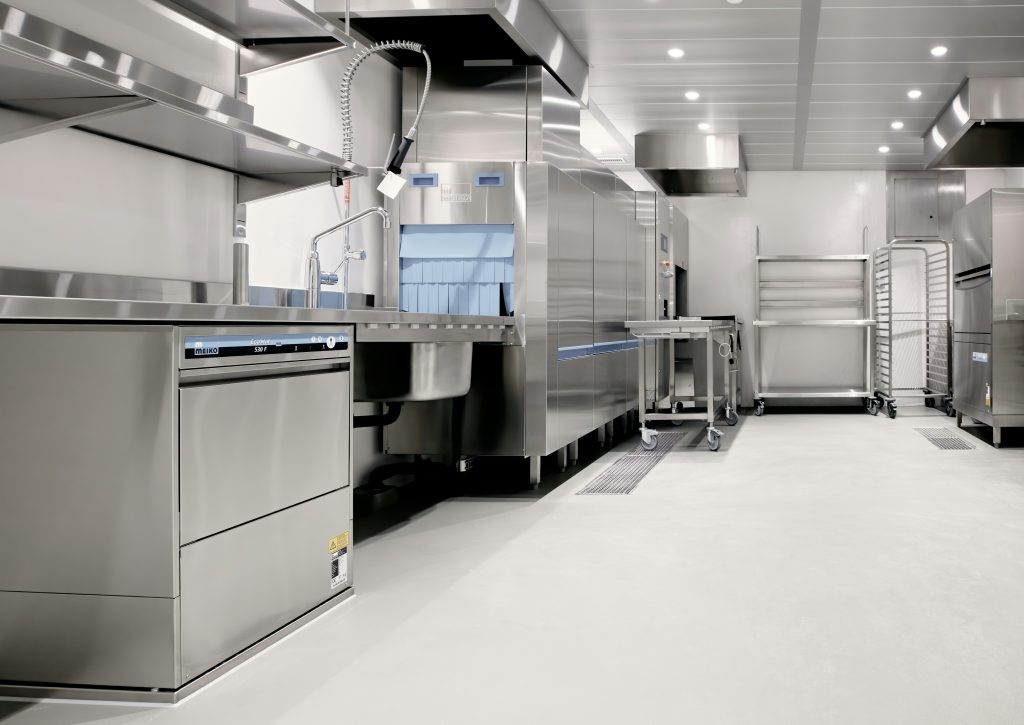
Restaurant kitchen floors face conditions that no residential surface encounters.
Thermal Shock and Temperature Swings
Boiling water, hot grease, and fryer oil make contact with the floor within seconds of a blast of cold air from an open walk-in cooler. A coating that can’t absorb those temperature swings develops micro-cracking that worsens over time.
Daily Chemical and Cleaning Exposure
Degreasers, sanitizers, citric acid from food prep, and alkaline cleaning solutions hit the floor during every closing shift. A surface that reacts to those chemicals tends to degrade faster than foot traffic alone would cause.
Constant Moisture and Humidity Issues
Between dishwasher spray, floor washing, condensation from refrigeration, and spills, a kitchen floor is wet for most of its operating hours. In Cleveland, where ambient humidity runs high through spring and summer, moisture has even less opportunity to evaporate between shifts.
Slip Resistance and Safety Standards
OSHA and local health codes mandate that commercial kitchen floors maintain adequate traction under wet and greasy conditions. Cleveland Concrete Coatings works with restaurant owners across Greater Cleveland who need to meet these standards without shutting down operations. A floor that passes inspection when new but loses texture as it wears creates escalating liability risk.
The Best Coating Systems for Cleveland Restaurant Kitchens
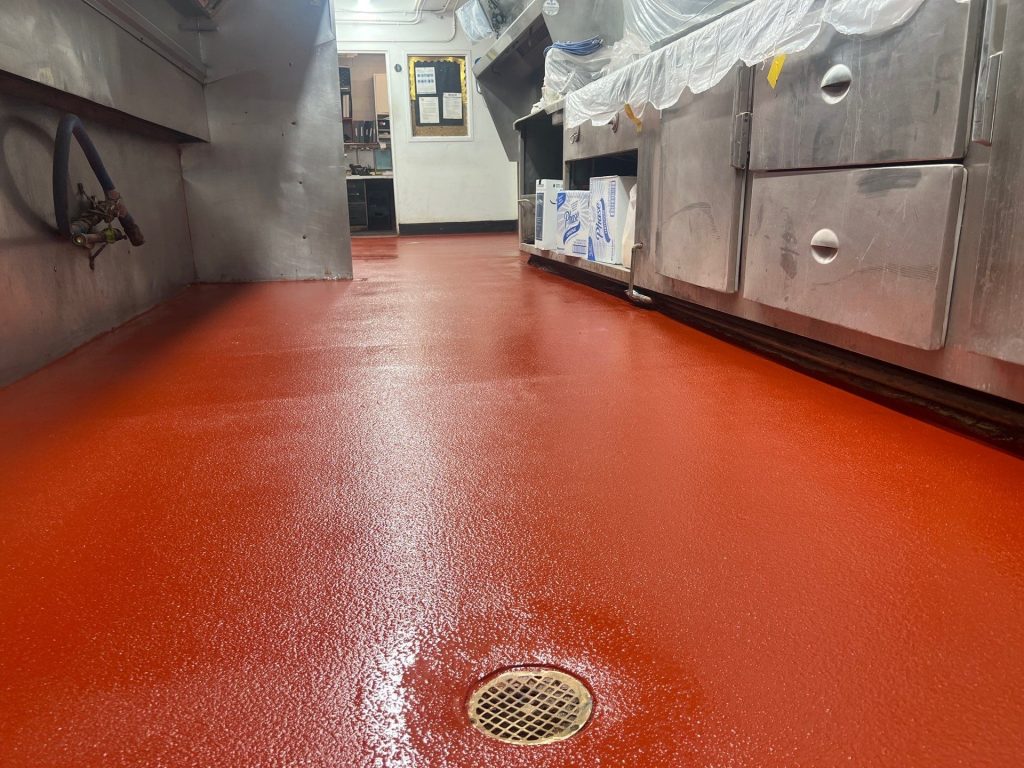
Three systems handle the demands of a commercial kitchen in Northeast Ohio.
Polyurea Polyaspartic
Cleveland Concrete Coatings’ polyurea polyaspartic system is 4x stronger than standard epoxy and installs in a single day. The polyurea base coat is flexible enough to handle thermal cycling without cracking, and the polyaspartic topcoat is chemically resistant, UV stable, and accepts anti-slip aggregate for wet-surface traction. Zero VOC emissions during installation mean the space is safe to occupy immediately after curing, with no toxic fumes affecting adjacent dining areas or staff.
For restaurants that need to minimize downtime, the one-day installation timeline is a significant operational advantage. A kitchen coated on Sunday is ready for Monday morning prep. For a broader look at how Cleveland Concrete Coatings approaches commercial concrete floor coating, our guide covers the full range of applications.
Epoxy
Epoxy creates a seamless, non-porous surface that resists chemicals, stains, and abrasion. It’s a proven option for kitchens with moderate traffic and standard cleaning protocols. The limitation for high-volume kitchens is thermal shock resistance. Standard epoxy can soften or crack under repeated extreme temperature swings from fryer to freezer. Kitchens with heavy frying or frequent boiling water contact should consider polyurea or urethane cement.
Urethane Cement
Urethane cement is the heavy-duty option for the most demanding kitchen environments. It handles thermal shock from sub-zero to boiling without cracking, resists the broadest range of chemicals, and tolerates higher moisture content in the concrete during installation. For high-volume restaurant kitchens, commercial bakeries, and food processing facilities, urethane cement is the system that holds under conditions that degrade other options.
The trade-off is cost and aesthetics. Urethane cement is more expensive than epoxy or polyurea and offers fewer decorative options. For a kitchen where function and code compliance matter more than appearance, that trade-off is straightforward. For more on how commercial epoxy flooring cost compares across systems, our pricing guide covers the numbers.
Frequently Asked Questions
What is the best floor coating for a restaurant kitchen in Cleveland?
For most Cleveland restaurant kitchens, polyurea polyaspartic or urethane cement coatings are the strongest options. Polyurea polyaspartic handles chemical exposure, thermal cycling, and daily wet conditions while installing in a single day. Urethane cement is the choice for kitchens with the most extreme thermal shock demands. Cleveland Concrete Coatings evaluates each kitchen’s conditions during a free on-site assessment.
Can a restaurant stay open during kitchen floor coating installation?
Partial operation is possible in some cases. Kitchens can be sectioned so one area is coated while the other remains in use. Polyurea polyaspartic systems cure fast enough to minimize downtime. Cleveland Concrete Coatings works with restaurant owners to plan installation schedules that reduce business disruption.
How long does commercial kitchen floor coating last?
A professionally installed polyurea polyaspartic kitchen floor carries a service life rating of 5 to 20+ years with proper care, depending on traffic volume and maintenance. Urethane cement systems are also designed for long-term performance in heavy-use kitchen environments. Both require proper surface preparation before installation and routine cleaning to reach their full service life.
Get Your Kitchen Floor Up to Code
The floor is the most used surface in a commercial kitchen, and it’s the one most likely to create a safety or compliance issue if it fails. Polyurea polyaspartic, epoxy, and urethane cement each solve the problem differently depending on the kitchen’s demands. Cleveland restaurant owners can request a free quote from Cleveland Concrete Coatings to find out which system fits their kitchen, their timeline, and their budget.

Benjamin & Andrew Smola are the owners of Cleveland Concrete Coatings, a concrete coating company based in Cleveland. With a hands-on approach and local expertise, Benjamin, Andrew, and their team are dedicated to delivering durable, high-quality flooring solutions for homes and businesses throughout the area.